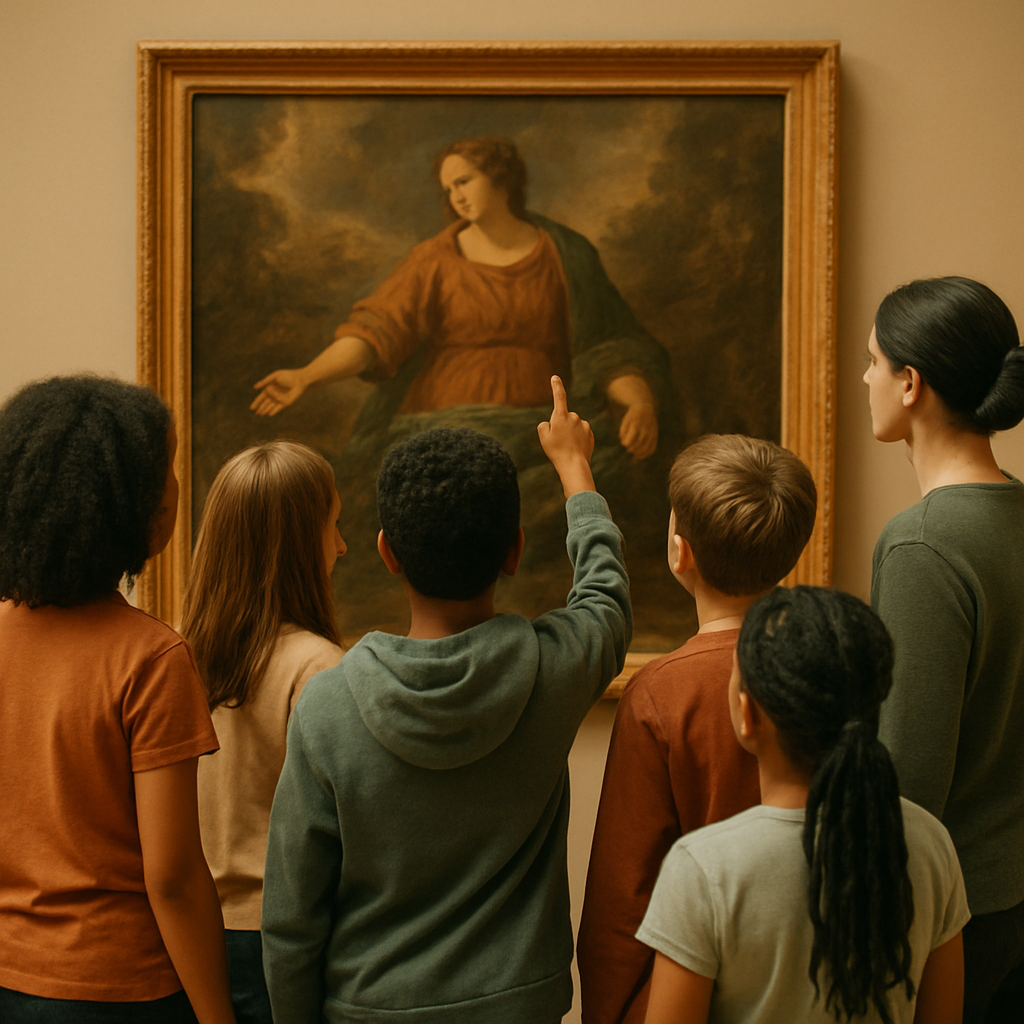
The three questions
Visual Thinking Strategies (VTS) is a research-based discussion protocol built around three questions, asked in sequence. That's it. Those three questions drive some of the most rigorous thinking students will do all year.
What's going on in this picture?
Opens the floor. Invites observation without demanding a 'correct' reading.
What do you see that makes you say that?
Asked after every observation. Turns a hunch into evidence-based argument.
What more can we find?
Pushes past the first impression and keeps the conversation going.
Why VTS works for ethnic studies
Visual art and digital media are the primary investigative texts in this course — not supplementary materials. A painting, a photograph, a social media image, and an AI-generated picture are all objects worth studying closely. VTS gives students a consistent, repeatable method for doing that work.
The equity rationale
A student still developing English fluency can analyze a work of art and engage in sophisticated ethnic studies thinking before grade-level reading would allow it. VTS honors partial language as legitimate intellectual contribution.
“I see a wall and I think it means they're trapped.”
That is evidence-based argumentation. That counts.
How to facilitate VTS
Your role is to facilitate the conversation, not to lead students to a predetermined answer. Move through these moves in order:
Display the image without introducing it
No artist name, no title, no context yet. Let students meet the work cold.
Ask question 1, then wait
“What’s going on in this picture?” Let silence do its work — resist filling it.
Paraphrase without evaluating
“So you’re noticing…” / “She’s pointing out…” Reflect contributions back without judging them right or wrong.
Ask question 2 after every observation
“What do you see that makes you say that?” This is where interpretation becomes evidence.
Ask question 3 to push deeper
After several responses, “What more can we find?” keeps students looking.
Reveal context last
Share artist, title, year, and community only after students have formed their own interpretations.
What to expect the first time
Students will wait for you to tell them the “right answer.” Resist. Your job in VTS is to facilitate, not evaluate. The discomfort of not being told what to think is part of the learning.
Trust the discomfort
By the third or fourth time you run VTS, students will start doing it to each other — asking “what do you see that makes you say that?” without prompting. That shift is the goal.